


Making
Why glass details are settled before tempering
Holes, cut-outs, slots and edges are more than visual details: they determine the sequence of making.
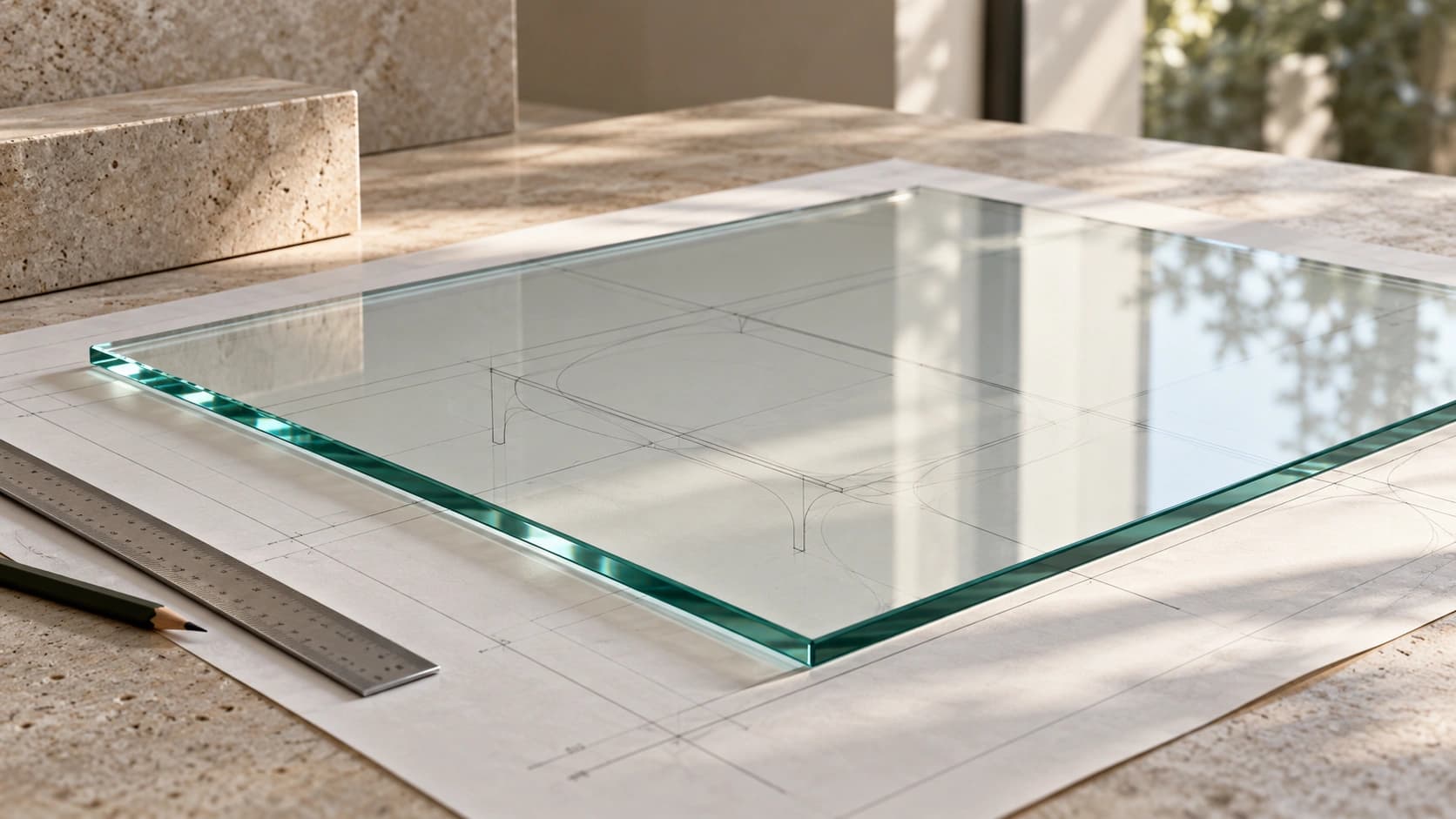
A joint may be almost invisible in a photograph of a table or console. During making, however, that small hole or the interval between two parts can determine the sequence of the entire job. Glass yields a more precise result when decisions about form and detail are recorded before processing begins.
This is especially important for tempered glass. A customer does not need to know every factory operation, but should know which choices cannot be corrected with a small adjustment later. The approved drawing should show more than overall dimensions: connection positions, installation orientation and the intended edge finish all belong there. Design and production can then discuss the same, specific piece.
The drawing comes first
Ordinary cutting and drilling are not carried out after a piece has been tempered. Connection points, edge form and cut-outs need to be resolved in the pre-production drawing.
The cost of a late change
A revised connection position or dimension after approval can require a redesigned and remade panel. Drawing approval is therefore part of the quality of the finished piece.
What to record for a custom order
Record dimensions, hole locations, edge form and finish, orientation and connections to complementary materials. Final feasibility follows a technical review.
What to check in a drawing
Read the drawing as if you were going to install the piece. Overall dimensions, hole or slot positions, distances from an edge, corner forms, the face intended to show and the position relative to the support should all be clear. A photograph conveys the desired character, but it is not accurate enough to define those details.
If an object contains several glass parts, identify each part in the drawing. That helps match panels to their positions during approval, handling and installation. Record any revision on the same controlled version of the drawing so that competing copies do not create confusion.
Edge, hole and hardware belong together
A hole is not simply a point on a plane. It relates to hardware, glass thickness, distance from the edge and the assembly sequence. Likewise, an edge finish should suit the parts touched by hand and seen from the room. Decisions made in isolation may appear attractive in a rendering but conflict in the real object.
After the overall form is chosen, review edge and connection details together. If the support or hardware remains undecided, a final glass drawing is premature. A technical review brings these choices into one coordinated design before making begins.
From approval to delivery
At the end of the design discussion, approve one identifiable drawing and specification. It should show the number of pieces, dimensions, glass type, edge finish and connection details. Any feature still subject to feasibility review should be marked as such.
After approval, do not assume that moving a hole or changing a dimension is a minor correction. Ask the maker to assess the effect on the panel and schedule. That extra check is part of the precision expected from a well-made glass object.